
 Written by
 For most students today, YouTube has become the default classroom. The moment a topic feels difficult, we search for a video hoping someone, somewhere, will explain it better. Sometimes that works. But many times, after watching two or three videos, the confusion only increases.
This happens more often than we admit—especially in subjects like biology, where understanding a process matters more than memorizing lines.
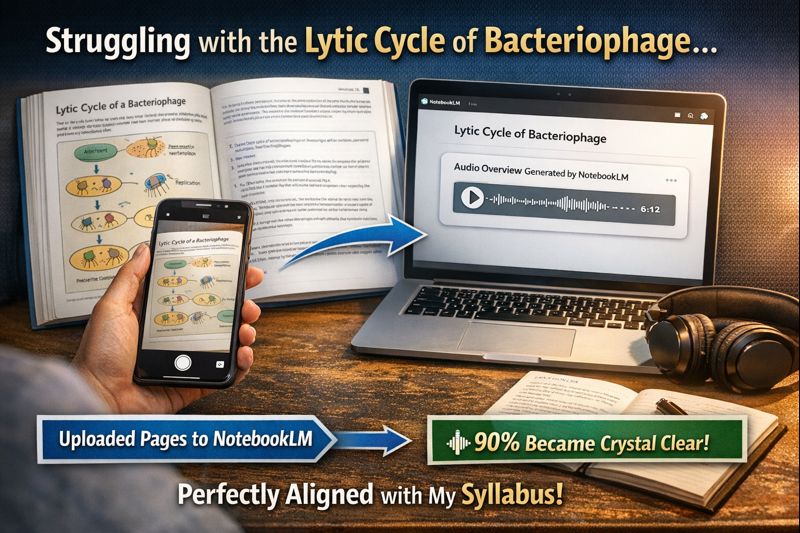
I faced this exact problem while studying the lytic cycle of bacteriophage. No matter how many videos I watched, none of them truly matched what was written in my book or what was expected in exams. That’s when I realized the issue wasn’t my ability to understand—it was the way I was studying.
Why YouTube Often Fails for Academic Learning
Most educational YouTube videos are designed for a wide audience. Creators explain concepts in a generalized way so that anyone, anywhere, can follow along. Your textbook, on the other hand, is written with a very specific goal: aligning with a syllabus and preparing you for exams.
Because of this difference, YouTube explanations often skip textbook terminology, change the order of processes, or simplify things so much that the core logic is lost. For exam-oriented learning, this mismatch can be frustrating.
The Mistake Most Students Make
When a topic feels difficult, our first instinct is to move away from the textbook. We assume the book is the problem. In reality, the textbook usually contains everything we need—but not in a format that suits everyone.
Dense paragraphs, formal language, and long explanations can make even simple concepts feel intimidating. The solution isn’t to abandon the book, but to change how we interact with it.
Turning Your Textbook Into Something Understandable
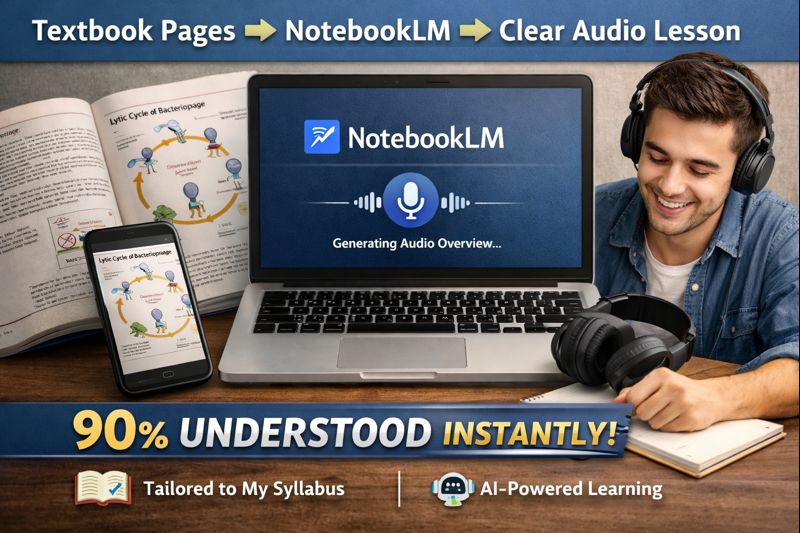
Instead of searching for another video, I decided to work directly with my book. I took photos of the exact pages that were confusing and uploaded them to NotebookLM. From those pages, I generated an audio overview that explained the content in simple language—without changing the structure or skipping important points.
Listening to the explanation felt very different from watching a random video. The sequence was familiar, the terms were the same, and the flow matched my syllabus perfectly. Within a short time, nearly 90% of the topic became clear.
What made the biggest difference was that the explanation was based on my book, not on an external source guessing what I needed.
Why This Method Works So Well
When learning stays aligned with your textbook, your brain doesn’t have to translate between different explanations. You’re not jumping between multiple interpretations of the same topic. Instead, you’re reinforcing the same idea in a different format—text to audio.
This approach is especially useful for biology and theory-heavy subjects, where understanding the sequence, definitions, and logic matters more than flashy animations.
Using YouTube the Right Way
This doesn’t mean YouTube is useless. It works best when you already have a basic understanding and want visual support or revision. But when you’re learning a topic for the first time, relying only on videos can actually slow you down.
Your textbook should remain the foundation. AI and videos should act as tools to support it—not replace it.
Final Thoughts
If YouTube videos are confusing you, it’s not a sign that you’re a weak student. It’s often a sign that your learning method isn’t aligned with your syllabus.
By starting with your textbook and using AI to simplify and explain it in a format you enjoy—like audio—you can make even difficult topics feel manageable. Studying becomes less about consuming more content and more about understanding the right content.
Sometimes, the smartest way to learn is not to search harder, but to study closer to the source.